Wednesday, July 2, 2014

Book on Flags and Emblems of Ukraine

  Cover of Ukraina: Herby ta Prapory = Ukraine: Coats of Arms and Flags

 Symbols of Hornostaivs'kyi  and Kalanchats'kyi Raions in the Kherson Oblast'

Professor Andriy Hrechylo, Head of the Ukrainian Heraldic Society, was instrumental in compiling,  Ukraina: Herby ta Prapory = Ukraine: Coats of Arms and Flags, a large format publication, that focuses on contemporary Ukrainian national, regional, and mucicipal symbols (published in 2010). The book is divided according to each oblast (province/ administrative unit), and includes the various raions (districts), cities and larger towns, that are located in each of the respective oblasts, along with their specific heraldry. The book is published through the Ukrainian Parliamentary Publishers.

This is the first thorough attempt to provide an inventory of more than 1,200 symbols of oblasts, raions, cities and tows of independent Ukraine. All regions of Ukraine are represented in this publication: from Transcarpathia in the west to the Donbas in the east; and Polissia in the north, to Crimea in the south. The book is available in the Elizabeth Dafoe Library's Slavic Collection's Reference area, under the call # Slav Ref CR 614.4 U39 2010.

Sunday, June 1, 2014

Zielnik- Herbarzem


     Zielnik Herbarzem (1613)

Authored by Polish botanist Szymon Syreniusz Syrénski, the Zielnik Herbarzem often referred to as the Polish Herbarium, was printed in Krakow in 1613.  It was acquired by the University of Manitoba Libraries in 1950. The Herbarium is composed of 1,538 pages of Polish, Latin and German text and illustrations. It contains an index of illnesses and cures in Polish and three separate indices of plants in Latin, Polish and German. It provides the origins of some of the plants that are used for medicinal and culinary purposes. One such example, is the use of beer yeast in alleviating painful and swollen limbs.

This very rare antiquarian book is housed in the Rare Book Room of the University of Manitoba Archives & Special Collections, Call Number: Slav RBR  QK 41 S97 1613. To view the Zielnik Herbarzem, please visit the Archives & Special Collections, 330 Elizabeth Dafoe Library.

Thursday, May 1, 2014

The Chytal'nia Prosvita fonds


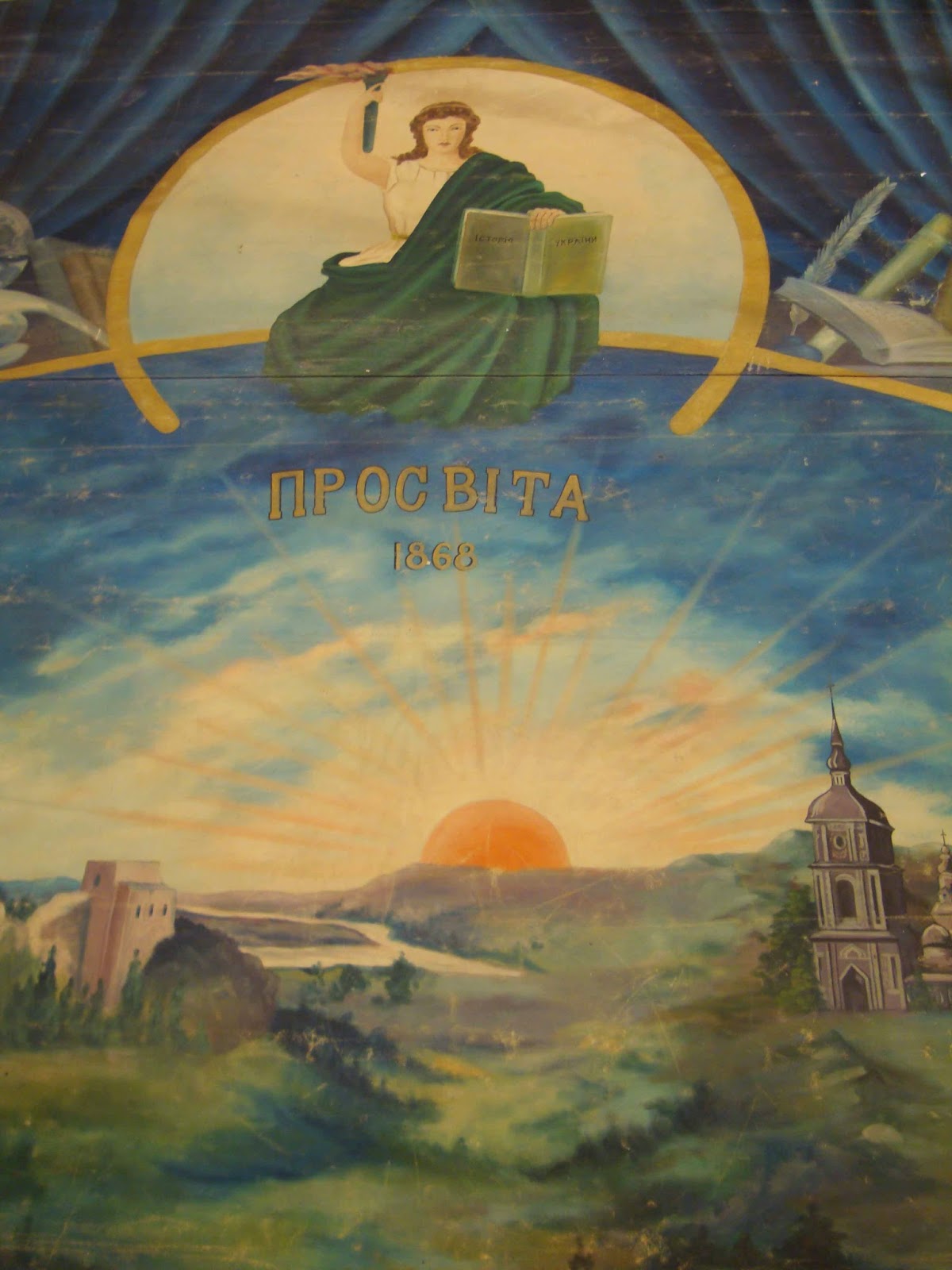
 Painted Backdrop of Mother Prosvita (approx. 5 ft  x 7 ft) found 
within the Ukrainian Reading Association - 
Chytalnia Prosvita fonds  Mss 361  
(Artist: Tony Hawrysh, 1938)

During the winter of 2012, the executive board of Chytal'nia Prosvita - The Ukrainian Reading Assocaition, donated its archives to the University of Manitoba Archives & Special Collections, to become part of the Archives of the Ukrainian-Canadian Experience.The fonds consists of the Ukrainian Reading Association - Chytal'na Prosvitas administrative history, minutes of the meetings, reports, correspondence, and "Ridna Shkola"s archival material. Its photograph collection includes 604 photographs, 275 negatives, 5 films, and 8 videocassettes. The Ukrainian Reading Association - Chytal'nia Prosvita fonds Mss 361, Pc 317, Tc 166 (A.11-91), are held in the U of M Archives & Special Collections.

The Ukrainian Reading Association, Chytal’na Prosvita was founded in 1903 by the members of Sts. Volodymyr and Ol'ha Ukrainian Greek-Catholic Cathedral in Winnipeg. The goal of the association is to promote and foster the Ukrainian culture (language, history, geography) through the education of ordinary people. The movement of the enlightenment society “Prosvita” started in Lviv, Western Ukraine in 1868. The first Ukrainians coming to Canada who were members of the mother organization in Ukraine brought this idea with them to Winnipeg. They first held meetings at the St. Nicholas Ukrainian Catholic Church, and later at Sts. Volodymyr and Ol'ha Cathedral and opened their school “Ridna Shkola” in 1918. In 1919 the members of the Chytal’na Prosvita discussed the possibility of purchasing their own building. Eight members of the association loaned their own money to purchase the house at 667 Flora Ave. The building was officially open on October 9, 1921 and blessed by Metropolitan Andrei Sheptyckyj. A list of donors who contributed to the Ukrainian Reading Association’s building was hung on the wall in the new building.

With the purchase of the new building, new organizations came into being such as the Benevolent Association of  Chytal’na Prosvita - the Mutual Aid Society (1927); the Women’s Organization of Maria Markovych (1931); and the “Plast” youth organization (1930). In addition, to the above mentioned, organizations many other groups and institutions used the building for their own activities: the Society of Volyn, and Research Institute of Volyn; the Ukrainian National Federation, the North Winnipeg Credit Union, and various musical and theatrical groups. “Chytal’na Prosvita” also had a large library with over 400 books. They were used by the Ukrainian community of the North End. 

Chytal’na Prosvita housed various cultural events, debates, lectures, concerts, amateur theatre and dance performances. Many prominent Ukrainian academics and artists visited Chytal’na Prosvita, including, E. Turula (composer), K. Andrysyshyn (educator), V. Avramenko (choreographer), O. Koshetz (director of choir), and many others who performed at Chytal’na Prosvita. 

In 1982 a big fire destroyed most of the building and although costly repairs kept it going for a while, it deteriorated to the point that the members of Chytal’na Prosvita decided to sell the building. Chytal'nia Prosvita's building finally closed its doors on May 31, 2001. The Chytal’na Prosvita’s executive board relocated to the North Winnipeg Credit Union, and their funds were transferred into a Designated Fund in the Shevchenko Foundation. The Ukrainian School “Ridna shkola” operates from the Andrew Mynarski School. The Reading Association School “Ridna Shkola” has 10 grades and opens its doors to students every Sunday. A large number of books from Chytal'nia Prosvita were donated to the Slavic Collection,  Elizabeth Dafoe Library (University of Manitoba), with the remaining books deposited throughout libraries in Ukraine.


Tuesday, April 1, 2014

21st J.B. Rudnyckyj Distinguished Lecture with Dr. Alexander Motyl

Poster/ Announcement of Dr. Motyl's March 14, 2014 Lecture 
Dr. Myroslav Shkandrij (U of M Dept of German & Slavic Studies) - right, Dr. Shelley Sweeney (Head, U of M  Archives & Special Collections) - centre, and Dr. Alexander Motyl (Rutgers University) - left                  


The 21st Annual J.B. Rudnyckyj Distinguished Lecture took place on Friday, March 14, 2014, in the University of Manitoba Archives & Special Collections. The guest lecturer for the event was, Dr. Alexander Motyl, a Professor of Political Science, at Rutger University (New Jersey).  His lecture titled, Will Ukraine Survive Yanukovych?, discussed the institutional devastation of Ukraine by the Yanukovych regime, examine the Euro Revolution as a response to that devastation, and evaluate Ukraine's post-Yanukovych prospects. Dr. Motyl also spoke of the reaction of Russia's Putin regime to the events in Ukraine, and how it has negatively affected Ukrainian-Russian relations.

The lecture was very well attended, and included both members of the university and external communities. The lecture was sponsored by the U of M Archives & Special Collections, the Slavic Collection (Elizabeth Dafoe Library), and the Department of German and Slavic Studies. Following the lecture, Dr. Motyl continued to answer questions at the reception that followed his talk. The complete lecture has since been place online.

Professor Motyl is a well-known scholar who has written extensively on the former Soviet Union and Ukraine, including several books, and many articles. Some of his books include: Communist Legacies and Post-Communist Trajectories: Comparative Perspectives on Ukraine and Russia (forthcoming); Holodomor Reader (Coeditor, 2012); Imperial Ends: The Decay, Collapse, and Revival of Empires (2001); Dilemmas of Independence: Ukraine after Totalitarianism (1993); and Will the Non‑Russians Rebel? State, Ethnicity, and Stability in the USSR  (1987). He is also a prominent commentator on contemporary Ukraine, and a regular contributor to World Affairs, a core journal on international affairs. In addition, He is well known as the author of an often-cited blog, that is maintained through the World Affairs website (URL: http://www.worldaffairsjournal.org/blogs/alexander-j-motyl )


Tuesday, March 4, 2014

The Polish Review

 Cover of the Polish Review, issue 4 (2012)

The Polish Review is a peer reviewed, English language interdisciplinary academic journal published by the Polish Institute of Arts & Sciences  in America.  It began publishing in 1956, with purpose of providing scholarly material  in the various fields of Polish studies encompassing Poland and the Polish diaspora. It has remained a core journal of Polish studies since its inception, and provided  essential scholarly content to counter propaganda-tainted publications in Poland during the communist era. The Polish Review publishes original English language research, reviews articles, book reviews, and provides translations of important Polish-language literary works and scholarly material. The periodical is indexed in several important bibliographies/ databases such as: the MLA International Bibliography; America: History & Life; Historical Abstracts and International Political Science Abstracts.

The complete run of the Polish Review (including current issues) are available electronically at the University of Manitoba Libraries, also, some bound issues of the periodical are available in the Bound Journal section on the third floor of the Elizabeth Dafoe Library, under the call number, Dafoe Per 943.8 P759 RE

Monday, February 3, 2014

Iraida Tarnawecky Fonds


 Dr. Tarnawecky conducting research at the Basilian Fathers Museum in Mundare, Alberta, August, 1967.
Iraida Tarnawecky Photograph Collection (PC 189)

Dr. Iraida Gerus Tarnawecky was born in Pochaiv, Volyn’, Ukraine, in 1924. In 1949, she obtained a B.Sc. from the Georgia Augusta University, Goettingen, Germany. After immigrating to Canada in 1950, she obtained an M.A. from the University of Manitoba (1964) and a Ph.D. from the Ukrainian Free University (Munich, Germany, 1965). Dr. Tarnawecky was married to the late Professor Emeritus Michael Tarnawecky (Faculty of Engineering), and the couple had two daughters, Marusia and Natalka. From 1963 to 1968, she served as a sessional and full-time lecturer with the Department of Slavic Studies (University of Manitoba).  In 1968, she was appointed Assistant Professor with the department, was promoted to the rank of Associate Professor in 1975, and to the rank of Full Professor in 1984. Upon her retirement from the Department of German and Slavic Studies in 1993, Dr. Tarnawecky was honoured with the title of Senior Scholar. She passed away on July 5, 2011.

Dr. Tarnawecky was a renowned Slavic linguist and onomastist, who had a keen interest in Slavic philology and Cyrillic paleography. Her publications include two books and many articles pertaining to her research field.  She  published both nationally and internationally. One of her most important publications is entitled East Slavic Cyrillica in Canadian Depositories (1981), a monograph identifying Canadian collections, both private and public, containing cyrillic manuscripts and early books. In order to compile the material for her research, Dr. Tarnawecky visited 87 institutions and private collections throughout Canada. In 1974, Dr. Tarnawecky was the first Canadian academic chosen in an agreement between the Canada Council and the former U.S.S.R. Academy of Sciences to carry out a research program in the history of Slavic languages at the Linguistic Institute in Moscow and Kyiv. She remained active throughout her career in various associations and committees, including Vice-President of the Canadian Society for the Study of Names, Chairperson of the Humanities Section of the Ukrainian Academy of Sciences in Canada (UVAN), member of the Senate for St. Andrew’s College Library, editior of the Onomastica series, and a former member of the Canada Council Selection Committee for Doctoral Scholarships in the Humanities and Social Sciences. In 2002, as part of their continued commitment to the Ukrainian community, Dr. Tarnawecky and her husband, funded an academic legacy.  The Professors Michael and Iraida Tarnawecky Distinguished Visiting Lecture Series was established at the Centre for Ukrainian Canadian Studies, St. Andrew's Colledge, at the University of Manitoba. 

 In 2004 and 2007 Dr. Tarnawecky donated two separate accruals of the her archives to the University of Manitoba Archives & Special Collections. The Iraida Tarnawecky fonds (Mss 213, Pc 189, Tc 112 (A.04-126, A.07-06) consists of: correspondence, research material pertaining to her field of study and career, photographs and audio-recordings. One of the recordings in the collection, is an interview with Dr. Savella Stechishin,, where she discusses the reasons behind her writing the famous Traditional Ukrainian Cookery cookbook, which has become a rare and much sought after publication.